VISUAL NOTE 01 / PRESSURE
How finger pressure changes shape and shadow
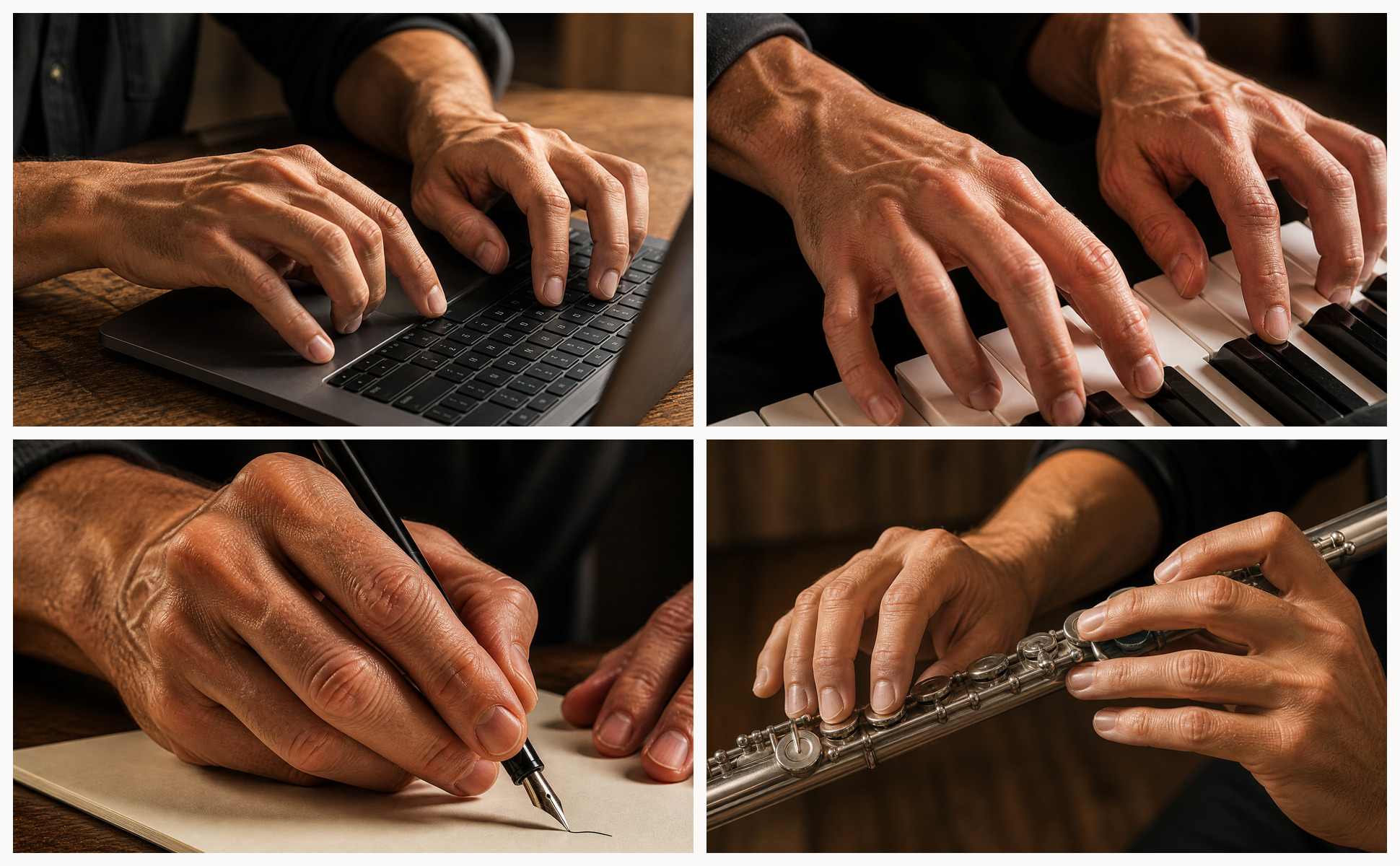
Four actions make four different demands on the fingers: typing on a laptop, playing a piano, writing with a fountain pen, and pressing the keys of a flute. Seen together, these AI-generated close views are useful not because they explain anatomy, but because they slow down changes that ordinary motion can hide. A fingertip meets a surface, another finger hovers, and a joint changes its angle before the next contact. This visual note follows those differences across the four scenes.
Independent motion, not a single gesture
A hand does not arrive as one fixed silhouette. At the keyboard, several fingers wait above the keys while one descends. At the piano, the spacing is wider and the curve through each finger is more pronounced. Writing concentrates the action into a smaller grip, with the thumb and forefinger stabilizing the pen while the remaining fingers support the hand. On the flute, extended fingers alternate between covering, pressing, and releasing. The sequence reveals a family of related movements rather than one generic hand pose.
Contact makes pressure visible
Pressure becomes legible where skin meets a key, pen, or instrument. The fingertip can look broader at the point of contact, while a hovering finger keeps a narrower outline. A bent joint may cast a short, dense shadow; a straighter finger produces a longer transition from light to dark. The images are AI-generated observations rather than medical evidence, yet the repeated contrast between contact and suspension gives the page a clear visual question: how does force alter the apparent shape of a finger?
Side light records the change
Light from the side separates knuckle, nail, tendon, and fingertip without needing a face or a wider scene. Small highlights mark the upper planes, while shadow gathers beneath the curve of each finger and around the object it touches. The result is a record of action through surface and shadow. The related Kindle book, The Shape of Fingers, extends this close attention across 16 AI-generated images devoted to independent finger motion, pressure, and the pauses between gestures.