VISUAL NOTE 02 / TENSION
Reading tension and release in tailored wool
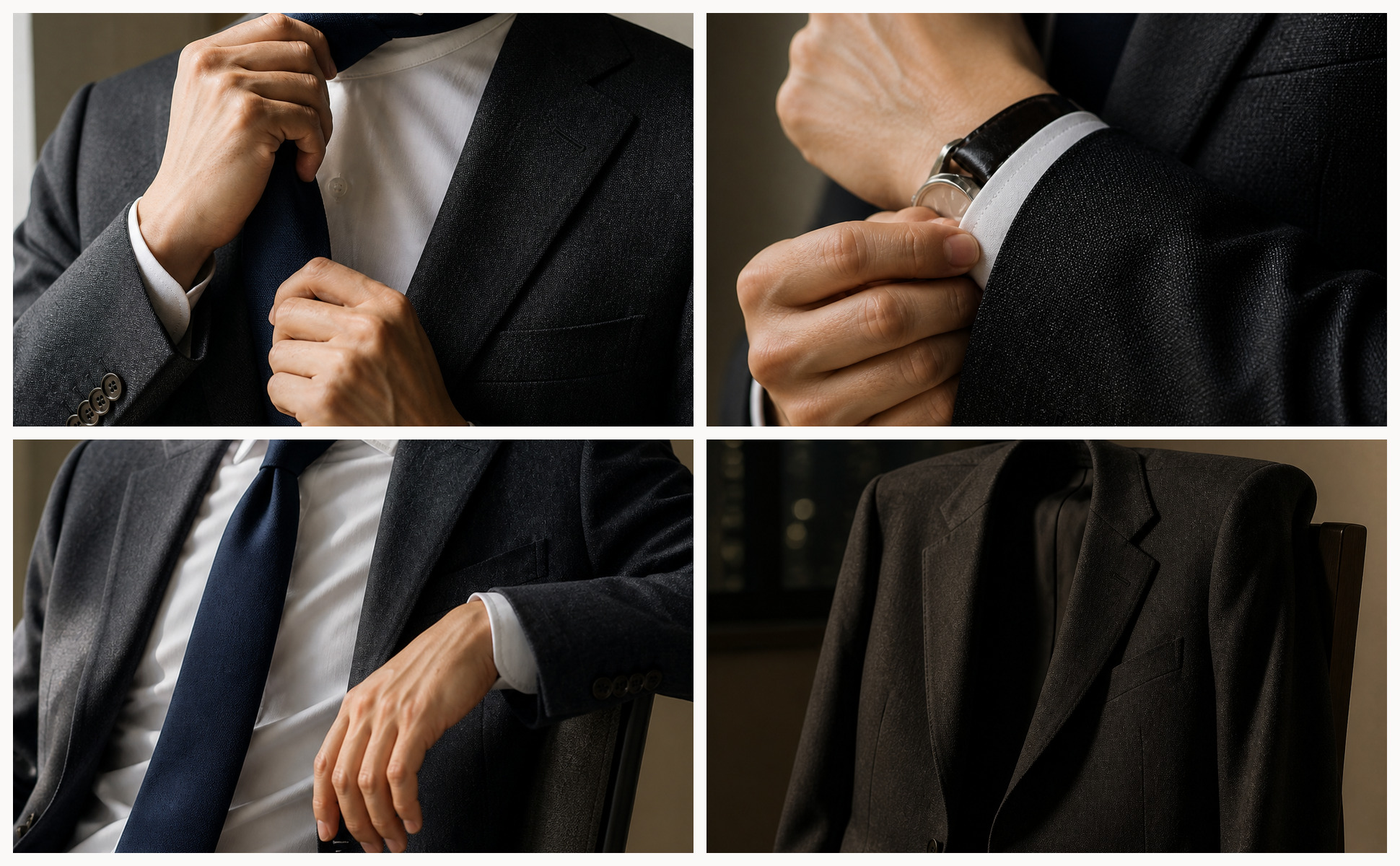
A tailored jacket is never only a flat sheet of cloth. Its cut establishes a line, the body interrupts that line, and movement redistributes the fabric again. These four AI-generated views move from an adjusted tie and lapel to a cuff beside a wristwatch, a seated jacket, and finally an empty jacket resting on a chair. The sequence turns familiar details into a study of where wool holds, folds, and releases.
The jacket is shaped before it moves
Tailoring gives cloth a structure before a wearer makes any gesture. The lapel rolls away from the chest, the shoulder keeps a controlled edge, and the sleeve falls from a set point. Adjusting the tie draws attention to that built form: hand, collar, and lapel meet in a small area, but each follows a different direction. This is why tension in a suit can appear deliberate rather than accidental. The garment is holding the memory of its cut while responding to the present action.
Cuff, elbow, and lapel as pressure points
At the wrist, layers meet: jacket sleeve, shirt cuff, skin, and watch. Their edges create short overlaps and compressed shadows. When the body sits, the elbow and waist introduce larger folds that travel across the jacket instead of stopping at one seam. The lapel behaves differently again, lifting from the shirt before settling back toward the torso. These details show tension as a route through the garment, not simply a wrinkle added to its surface.
Stillness completes the sequence
The empty jacket on the chair provides a useful counterpoint. Without an arm or shoulder inside it, the cloth keeps some constructed volume but gives more freely to gravity. That quieter image makes the earlier pressure points easier to read. These scenes are AI-generated visual studies, not photographs of a real model or instructions for judging garment fit. The related Kindle book, The Shape of a Suit, develops the same question across 16 images of tailored cloth, body movement, texture, and shadow.